Disclaimer The articles excerpted on this site report on the state of the industry as seen by mainstream media, and do not necessarily reflect the opinion of the officers of the ILWU Coast Longshore Division.
|
 The new no-frills service will connect California with the Taicang Gateway, 60 km north of Shanghai.
At a time when only the bravest might consider a major investment in container shipping by way of a brand new venture as a bright idea, next month TCC – The Containership Company – say they will launch their new “no frills” service between the two countries. The new company, modelled on the budget airline principle, say they will launch from a port 60 kilometres North of Shanghai for a direct voyage to California. There will be no infrastructure for collections and deliveries apparently, simply shipment of the boxes Port to Port from the Taicang Gateway international container terminal. The service is promised to commence on the 17th April with arrival at either Long Beach or Los Angeles on the 2nd May.
Many in the industry will be watching the progress of this new operation with keen eyes. By offering a simplified tariff, provided they can stick to it, and no allegiance to other shipping interests, the way is clear for a small predator to pick up a useful sector of the trade. Whether the model can be extrapolated to other destinations is open to question.
From the Handy Shipping Guide, March 12, 2010
Korea’s shipbuilding industry is seeing some signs of recovery after struggling from declining orders during the global recession. Samsung Heavy Industries announced on Tuesday that it won deals worth US$750 million from four European shipmaking firms to build nine oil tankers. Industry sources say Hyundai also could soon receive orders to build vessels for a Greek shipping company. This would be the conglomerate’s first shipbuilding deal since September 2008 due to a drop in global orders and prices. Last month Angola’s state-run oil company Sonangol awarded a deal worth around $340 million to Korea’s Daewoo Shipbuilding & Marine Engineering. Under the deal the shipmaker will deliver five crude oil carriers to the African country between 2011 and 2013.
But some say that difficulties are expected to lie ahead for the time being until the problem of excess supply of ships is resolved.
From the Chosun Ilbo, March. 11, 2010
Two of Japan’s largest shipping firms, NYK and “K” Line, reached agreements with shipbuilders to convert some container ship orders to orders for bulk carriers and other vessels, as demand for container shipping is expected to take time to make a full-fledged recovery.
NYK agreed … to convert seven of its 14 container ship orders to orders for three bulk carriers, two very large crude carriers and two product tankers that carry naphtha and other petroleum products. “K” Line agreed to convert five of its 31 container ship orders placed with various shipbuilding companies to orders for bulk carriers.
From the Journal of Commerce, March 10, 2010
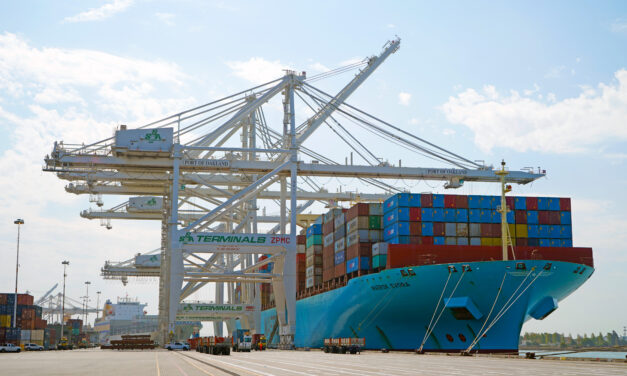
 An Evergreen ship at the Port of Tacoma
Taiwan’s Evergreen Marine Corp plans to expand its fleet to cope with a recovery in container shipping since the end of the global economic crisis, a newspaper said Tuesday. Evergreen, the world’s fourth-largest maritime shipping company, plans to buy at least a dozen vessels that can carry 7,000 to 8,000 standard-sized shipping containers, the Economic Daily News reported. A company executive said Evergreen expected an improved business climate as the global economic crisis eases, particularly since China’s free-trade agreement with the Association of South-East Asian Nations took effect on January 1. Evergreen has 150 container ships and hopes to eventually become the world’s largest shipping line.
From Macor Shipping, March 11, 2010
The Port Authority of New York/New Jersey unveiled a clean truck program Wednesday that will eventually require all trucks visiting the port to have 2007 model year engines. The program will ban trucks with pre-1994 model year engines by January 2011 and will ban pre-2007 model year engine trucks by 2017.
The Owner-Operator Independent Drivers Association’s leadership watched clean truck programs closely as they were implemented at Los Angeles and Long beach California. … The American Trucking Associations issued a statement Wednesday thanking the New York/New Jersey ports for not adopting an employee-driver mandate similar to the requirement created by the Port of Los Angeles.
From Land Line Magazine, March 10, 2010
Ocean carriers are returning laid-up container ships to service at a faster pace to keep up with growing cargo volume, according to a new report. Carriers will have 40 additional vessels of over 3,500 20-foot equivalent units capacity by the end of April, Alphaliner said, including 15 drawn from the pool of ships that have been idled since the beginning of the global downturn. The remainder will consist of shipyard deliveries and vessels being freed up by their current charterers. Demand is increasing with the introduction of new services, capacity upgrades on a few “loops” and additional extra slow steaming, according to Alphaliner, the Paris-based consultancy.
From the Journal of Commerce, March 10, 2010
The challenges facing the ports of Seattle and Tacoma can be neatly listed: 1) The trade collapse from the Great Recession; 2) The looming opening of wider Panama and Suez canals, allowing much Asian cargo to bypass the West Coast; 3) Prince Rupert, a day’s sailing distance closer to Asia, and 4) Washington’s slowness to improve transportation infrastructure.
Now you can add a fourth, at least for the middle distance: A melting Arctic Ocean thanks to climate change. A report from the Stockholm International Peace Research Institute discusses how China is quietly preparing for the strategic and trade implications of the ocean being navigable during the summer months. It would speed transit times, especially between Asia and Europe.
From the Seattle Times, March 9, 2010
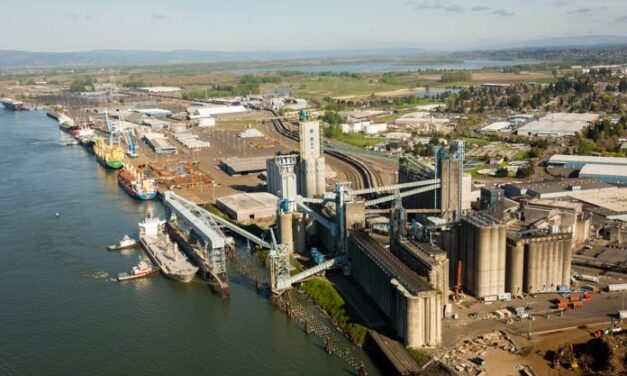
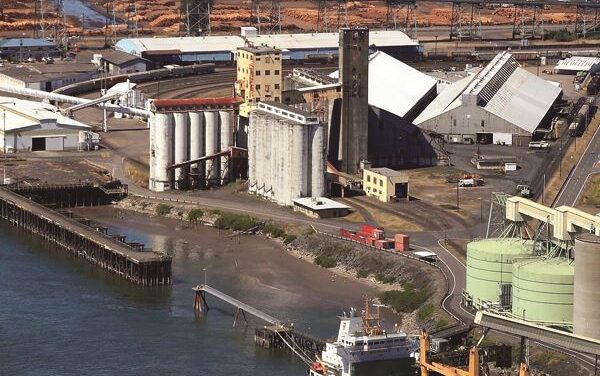
 Longview's Berth 9 will be the site of the new $200 grain elevator buit by EGT Development, Inc. Click on the photo to read the Longview Daily News.
The Port of Longview increased its revenue 7 percent from 2008, when it hauled in $23.5 million. Before then, the port had never broken the $20 million mark. The port’s 2009 operating expenses also rose 9 percent to $22.4 million, and it finished with an annual income of $2.7 million. The revenue surge was fueled by rising wind-energy imports, a resurgence of log exports and steady business for the bulk food and chemicals transported at Berth 2. Wind imports jumped by 26 percent, and log exports rose 91 percent in 209 because the port found new markets in China and Korea, port officials said. Port imports jumped 9 percent in 2009, and exports were up 13 percent. Overall, the port handled 1.5 million tons of cargo in 2009, an increase of 12 percent from the previous year.
The Port of Longview seems solid for the next few years, the port director said. The port expects EGT Development LLC to complete its $200 million grain terminal next year, and log exports are recovering after struggling through the last decade.
From the Daily News, March 9, 2010
Since November 2009, 100 older diesel trucks servicing the Port of Seattle have been permanently removed from service. … Replacement trucks obtained as part of the ScRAPS Program can qualify for a no-cost exhaust retrofit to further reduce their emissions. The program is designed to help the Port of Seattle meet the goals of the Northwest Ports Clean Air Strategy to remove all trucks with pre-1994 engines from port operations by the end of 2010 and to remove all trucks with pre-2007 engines by 2017. Scrapping these first 100 trucks and replacing them with more modern vehicles will prevent the emission of nearly 1.5 tons of fine particulates each year.
From Heavy Duty Trucking magazine, March 9, 2010
A $22 million federal stimulus grant project is underway at the Port of Los Angeles this week, which will result in improvements along a 1.3-mile stretch of Harry Bridges Boulevard in Wilmington, Calif. Harry Bridges Boulevard, part of the National Highway System, connects John S. Gibson Boulevard with Alameda Street, and is the main truck route from San Pedro and Wilmington to State Route 47.
The project is the first grant awarded to the Port of Los Angeles through the American Recovery and Reinvestment Act (ARRA) of 2009. Construction is expected to be completed in January 2012.
From TruckingInfo.com March 10, 2010
There’s no getting around it. Cargo ships are getting larger, and if ports are going to survive, they’re going to have to get larger as well. As big as the port of Baltimore is, it isn’t big enough. Not when new cargo ships are headed toward super-sized proportions. Before tugs can move the oversized ships into Baltimore, a new 50-foot berth with taller cranes must be built. A groundbreaking for that berth gave the governor a photo-op on Monday. “It’s going to support 2,700 permanent jobs to handle the increased container traffic that will come through our port,” said Governor Martin O’Malley.
The Panama Canal is also being expanded to handle the larger ships and to stay in business as a critical shortcut. The new berth will take two years to complete.
From WJZ 13 Baltimore, March 9, 2010
North German shipowners control 35 per cent of the world’s container vessels, managing many of the ships that facilitated China’s export boom of the past decade. They deal with Taiwanese or Chilean shipping lines or Korean shipyards as readily as Thomas Buddenbrook dealt with trading partners across the Baltic in Riga. As a result, northern Germany faces the biggest storm ever to hit container shipping. The prosperity of ordinary citizens, several large banks and even federal states is in peril, alongside that of well-heeled shipowners.
From the Financial Times, March 9, 2010
 Longshoremen stand atop log rafts and sit inside crane cabins while loading logs into the cargo hold of the ship Koombana Bay, the first log ship to be loaded in Port Angeles since the year 2000. Click on the image to read the Peninsula Daily News article.
Logs from West End forests were lifted aboard a year-old freighter ship Monday in a three-day operation that will mark Port Angeles’ first log export operation in nearly a decade. Eighteen longshoremen — mostly from Port Angeles — started a packed three-day schedule loading the 554-foot Koombana Bay. The ship will then head to Longview to be filled with logs before it heads out on a 15-day journey to South Korea.
The absence of ships loading logs in Port Angeles Harbor has been a constant reminder of the slowdown in the industry, said George Schoenfeldt, a former ILWU dispatcher and current Port Commissioner. “The main thing is the economic benefit to the community.”
From the Peninsula Daily News, March 9, 2010
The slot charter agreement between Horizon Lines and Maersk Line on the Trans-Pacific 1 (TP1) service will end in December 2010. This weekly service currently calls Yantian, Xiamen, Kaohsiuing, Los Angeles, Oakland, Honolulu and Guam. Horizon Lines operates five vessels in this service. Maersk Line has been utilizing the entire 1100 FFE capacity eastbound, and uses a small amount of space on the westbound rotation. Empty westbound Maersk Line containers are utilized by Horizon Lines for their West Coast customers to ship cargo to Hawaii and Guam.
“Maersk Line is carefully watching market developments and reviewing customer requirements. Once these are made clear we will release a plan designed to replace TP1 capacity,” said a Maersk executive.
From the Manila Bulletin, March 8, 2010
 MSC ship in Brasil
Customers of shipping lines created container shipping’s deepest crisis and contributed to persistent and damaging price instability in the sector, the head of the industry’s second-biggest operator has said. Gianluigi Aponte, chief executive of Mediterranean Shipping Company (MSC), told the Financial Times that every main line would survive the crisis, in which earnings per container have slumped well below operating costs. But shippers – shipping lines’ customers – had abused industry overcapacity to stir up price competition, he said. “Shippers are not that deep,” Mr Aponte said. “They worry always who will ship for $50 less. The shippers are concerned solely by the price.”
From the Financial Times, March 7, 2010
|
|